Entre les collines crayeuses du Pays d'Othe au sud et les alluvions de la plaine de Champagne humide au nord, les sols de Troyes présentent des contrastes mécaniques marqués qui influencent directement la réponse sismique des structures. Dans le quartier historique du Bouchon de Champagne, les remblais anthropiques multicentenaires côtoient les formations de craie altérée du Turonien, tandis que les extensions récentes vers Saint-André-les-Vergers reposent sur des limons de plateau sensibles au tassement. Notre équipe technique intervient sur l'ensemble de l'agglomération troyenne pour concevoir des systèmes d'isolation sismique à la base adaptés à cette géologie hétérogène, en utilisant les données de MASW pour caractériser le profil de vitesse des ondes de cisaillement (Vs30) ou en recourant aux sondages SPT lorsque la stratigraphie locale demande une reconnaissance mécanique plus fine avant le dimensionnement des isolateurs.
Sur les craies altérées du Turonien à Troyes, un système d'isolation sismique à la base bien calibré peut réduire les efforts horizontaux de 60 à 80 % comparé à un encastrement classique.
Méthodologie appliquée à Troyes
Facteurs critiques du terrain à Troyes
In Troyes, which falls under seismic zone 2 (low), the requirements from Eurocode 8 (NF EN 1998-1:2005) and the decree of October 22, 2010 concerning building seismic classification can catch project owners off guard if they are not well-acquainted with seismic risk in Champagne. While the regional hazard remains modest compared to the Antilles or the Alps, the highly variable soils of the Pays d'Othe cuesta and the plain's alluvium can locally amplify seismic waves through site effects. Structures in category III or IV (public facilities, hospitals, emergency centers) built on dry valley fills or fractured chalks face resonance risks when their natural period matches that of the ground. Base seismic isolation addresses this weakness by shifting the building's natural frequency toward longer periods where seismic energy is inherently lower, also preventing non-structural damage—the main source of post-earthquake economic losses.
Nos services
Our seismic design service spans the entire project lifecycle, starting with dynamic site characterization and extending through installation monitoring of isolators at the Troyes construction site. We work alongside approved inspection agencies and local general contractors to incorporate isolation systems into the construction schedule without causing delays.
Analyse modale et spectrale du site
Geophysical measurement campaigns (MASW, seismic refraction) are conducted to obtain the Vs30 profile and the required soil class, an essential first step for selecting the isolator type and sizing the seismic bearings.
Dimensionnement et spécification des isolateurs
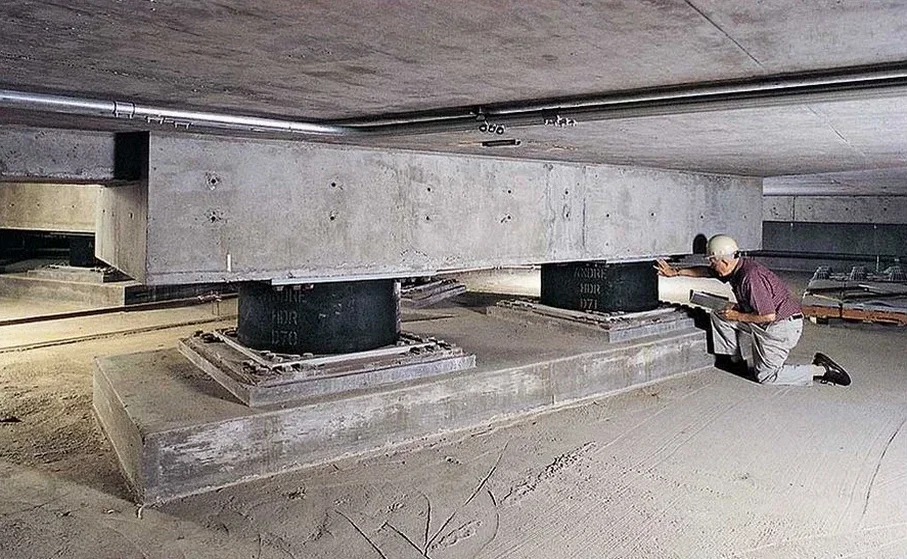
Using the elastic response spectra specified in Eurocode 8, we design high-damping rubber bearings (HDRB) or curved surface sliders, prepare the technical specifications, and support the project owner in supplier tendering.
Vérification post-pose et maintenance
Post-installation, we inspect the geometric and mechanical compliance of the placed isolators, check the peripheral seismic gaps, and draft the periodic inspection schedule required by French regulations.
Consultations fréquentes
Pourquoi prévoir une isolation sismique à Troyes alors que la zone sismique est faible ?
Even in zone 2, base seismic isolation is warranted for importance category III or IV buildings, or when site analysis indicates resonance between ground and structure. In Troyes, weathered chalk or historical fill can locally amplify seismic waves, and isolation safeguards not only the structure but also internal equipment and contents, dramatically cutting post-earthquake operational losses.
Quelle est la différence entre un isolateur en élastomère et un appui à glissement ?
High-damping rubber bearings (HDRB) incorporate a lead core for energy dissipation and elastomer layers for horizontal flexibility. Friction pendulum sliding bearings employ a curved surface to create a restoring force while dissipating energy through friction. The selection is based on the local seismic spectrum and the structure's weight.
Combien coûte une étude de conception d'isolation sismique à la base à Troyes ?
A full base isolation design study for a new building typically costs between €3,480 and €6,840, depending on structural complexity and the preliminary geophysical campaign. This fee covers modal analysis, isolator sizing, specification writing, and technical support through approval of the installation plan.
Faut-il prévoir une maintenance des isolateurs sismiques après la construction ?
Indeed, standard NF EN 15129 and the AFPS guide require a periodic inspection protocol for isolators. Every 5 to 10 years, checks must include no elastomer cracking, no corrosion of connection plates, and proper seismic gaps around the superstructure. Isolator replacement is feasible but needs to be planned from the design phase.